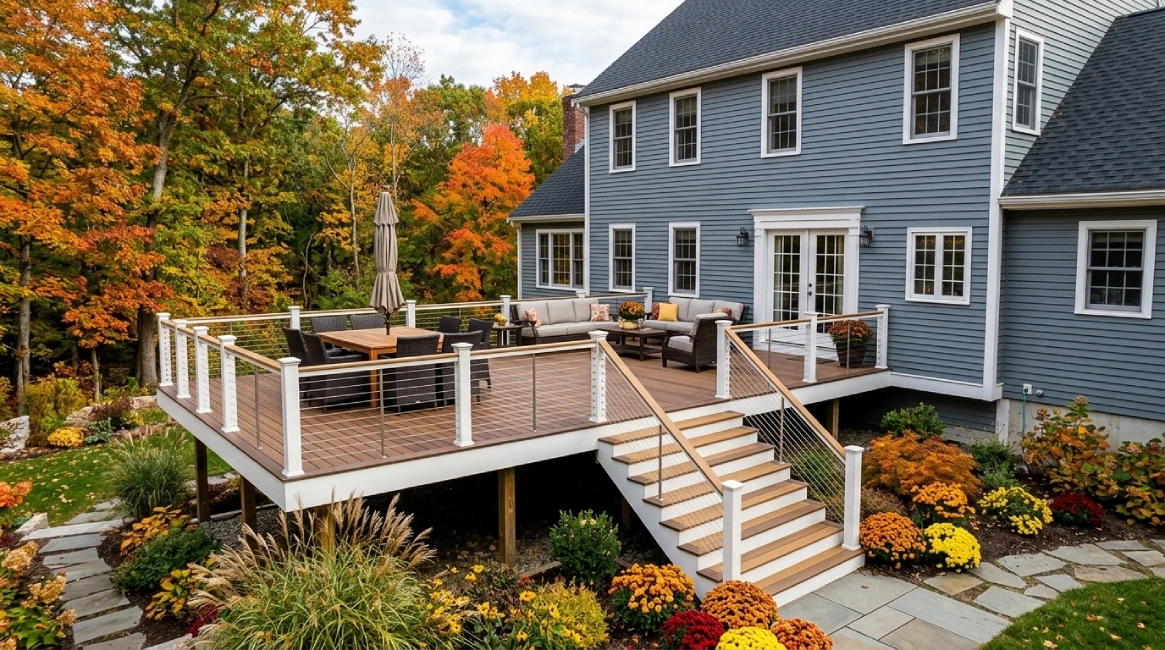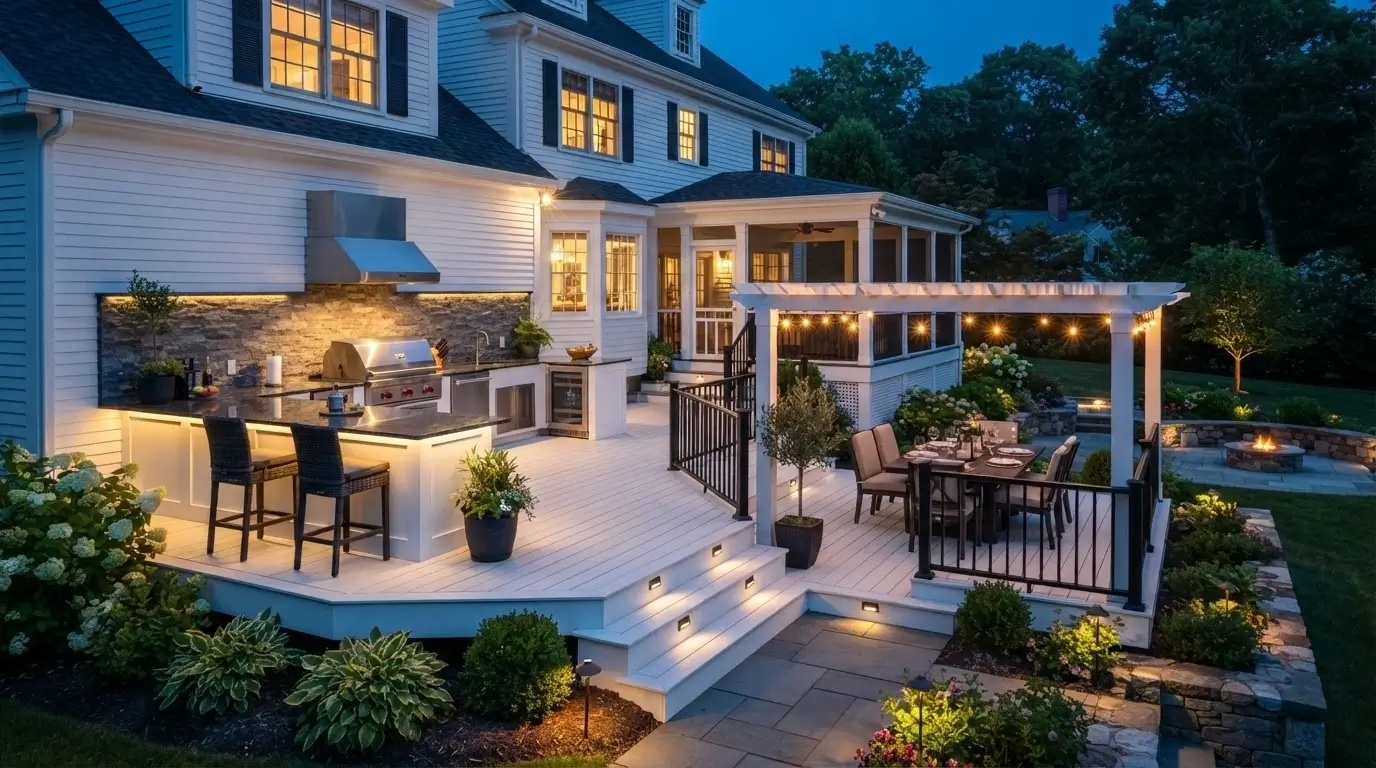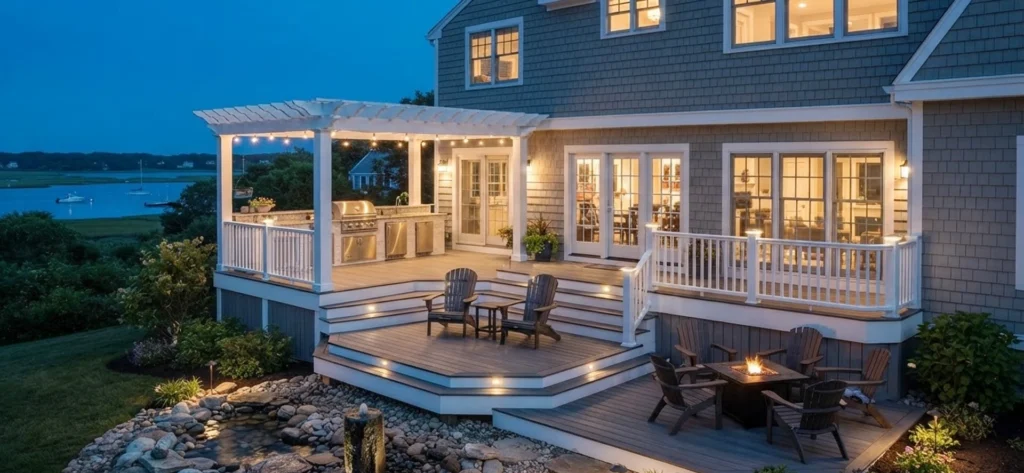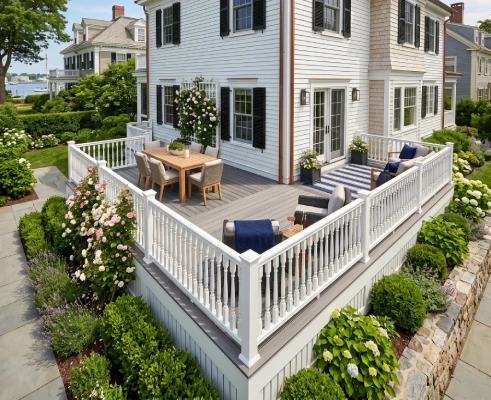


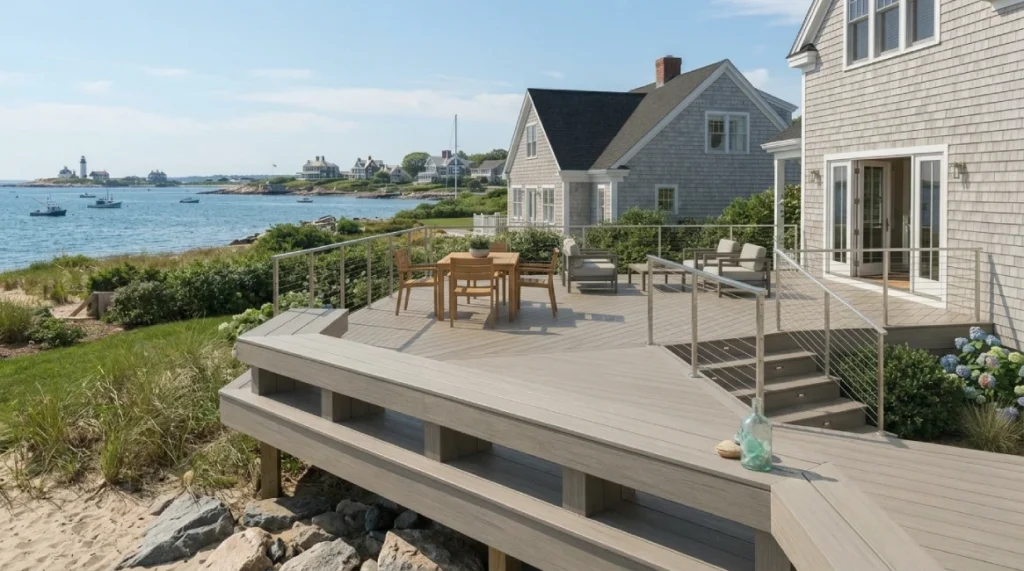

Composite Decking in New England
Board specs are easy to find. What’s hard to find is which composite decking still looks new after a decade of freeze-thaw, ice dams, and salt air — and how it has to be installed here. That’s what we do, on 2,000+ decks across six states.
Why Composite Is Our Most-Requested Decking
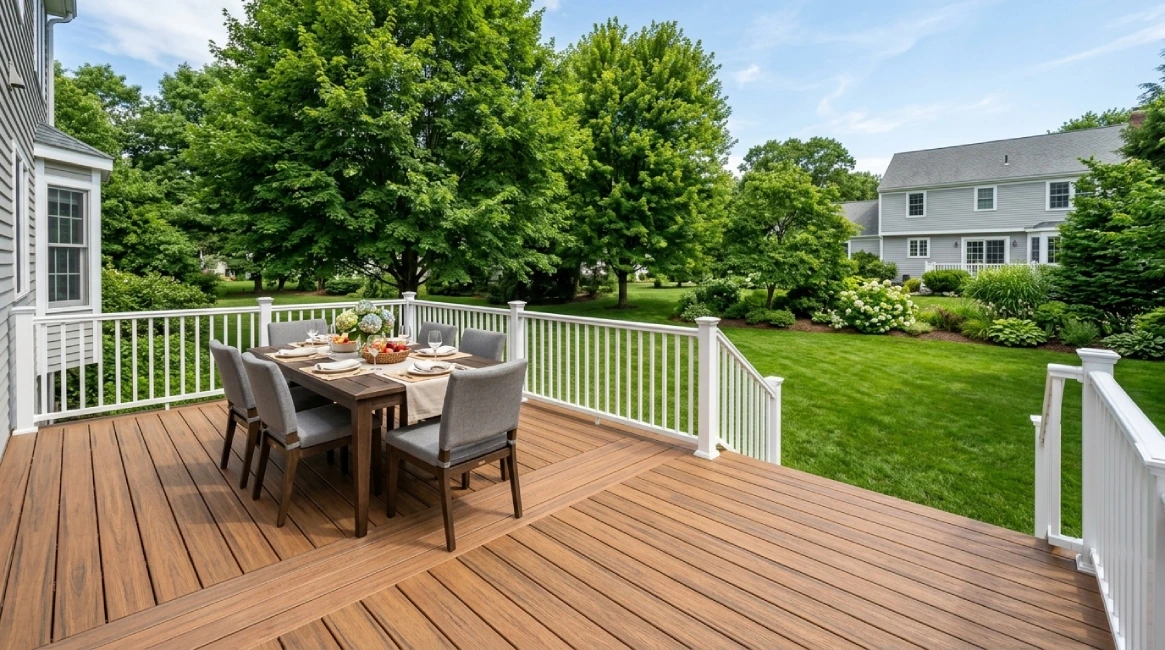
Ask ten homeowners what they want from a new deck and most say the same thing: looks like wood, acts nothing like it. That’s composite decking in one sentence — wood fiber and recycled plastic, wrapped in a protective polymer cap that never needs painting, staining, or sealing.
It’s the material we install more than any other across New York and New England. But “composite” isn’t one product — it’s a category spanning budget scalloped boards to premium four-side-capped lines, and the gap between them shows up around year eight of a New England winter cycle. This page is the honest version of that conversation.
Why Composite Decking Behaves Differently Here
National guides are written for a national average climate. We don't have one. Here's what actually matters in our six states:
1. Freeze-thaw is the real test, not summer sun
Water gets into any micro-gap, freezes, expands, and works the material apart. This is what destroys uncapped and cheap composite by year eight — and why we only install capped composite. The cap is the difference between a board that admits water and one that doesn’t.
2. Snow load stresses the substructure, not the surface
A New England roof-slide of wet snow can put serious load on a deck. Composite boards themselves handle it, but they’re only as good as the framing beneath. We size joists and set spacing for real regional snow load — and tighter joist spacing (12″ on center) is required for many composite lines, especially on diagonal board runs. Miss this and you get bounce, then sag.
3. Salt air changes your hardware, not just your board
Within roughly five miles of the coast — the Cape, South Shore, the RI and CT shoreline — standard fasteners corrode. We spec stainless hardware and coastal-rated systems as standard, because a perfect board on rusted screws is a failed deck.
4. Thermal movement is bigger with our temperature swing
Composite expands and contracts with temperature, and New England swings from -10°F to 95°F. That means correct gapping at butt joints and perimeters — done to the manufacturer’s spec for our climate, not eyeballed. Get it wrong and boards buckle in July or gap open in January.
5. Ice-melt chemistry matters
Rock salt and calcium chloride are hard on some surfaces. We’ll tell you which products are safe on your specific board line — a detail that never appears in a national buying guide.
How to Read a Composite Board Like a Builder
Capped vs. Uncapped
Uncapped Composite
Exposed wood-plastic material that can scratch, stain, and slowly absorb moisture over time. Largely phased out by quality manufacturers.
Capped Composite
A tough polymer shell wraps the board — three sides on most premium lines, all four on the best. Resists scratching, staining, and moisture completely.
Grooved Edge vs. Square Edge
Grooved Edge Boards
A routed channel along each edge lets hidden clips secure the board invisibly — the standard for a clean field of decking.
Square Edge Boards
Used where the board’s edge will show — stair treads, drink rails, and the deck’s perimeter — fastened with color-matched screws.
Solid vs. Scalloped Bottom
Scalloped Bottom
Ridges underneath use less material, cutting weight and cost — a smart budget lever for larger decks with standard joist spacing.
Solid Bottom
A flat, consistent underside for maximum rigidity — the only choice for drink rails, stair treads, and hidden plug systems.
What's New : Composite Decking Innovations
The industry moves fast. Here's what actually launched this year, and whether it's worth paying for on your project.
- Fire-resistant composite (Trex, Deckorators)
— new ignition-resistant lines with independently tested slower flame spread. Our take: matters most on exposed or high-risk sites; rarely necessary on a typical shaded New England backyard.
- Heat-mitigating boards (Trex SunComfortable)
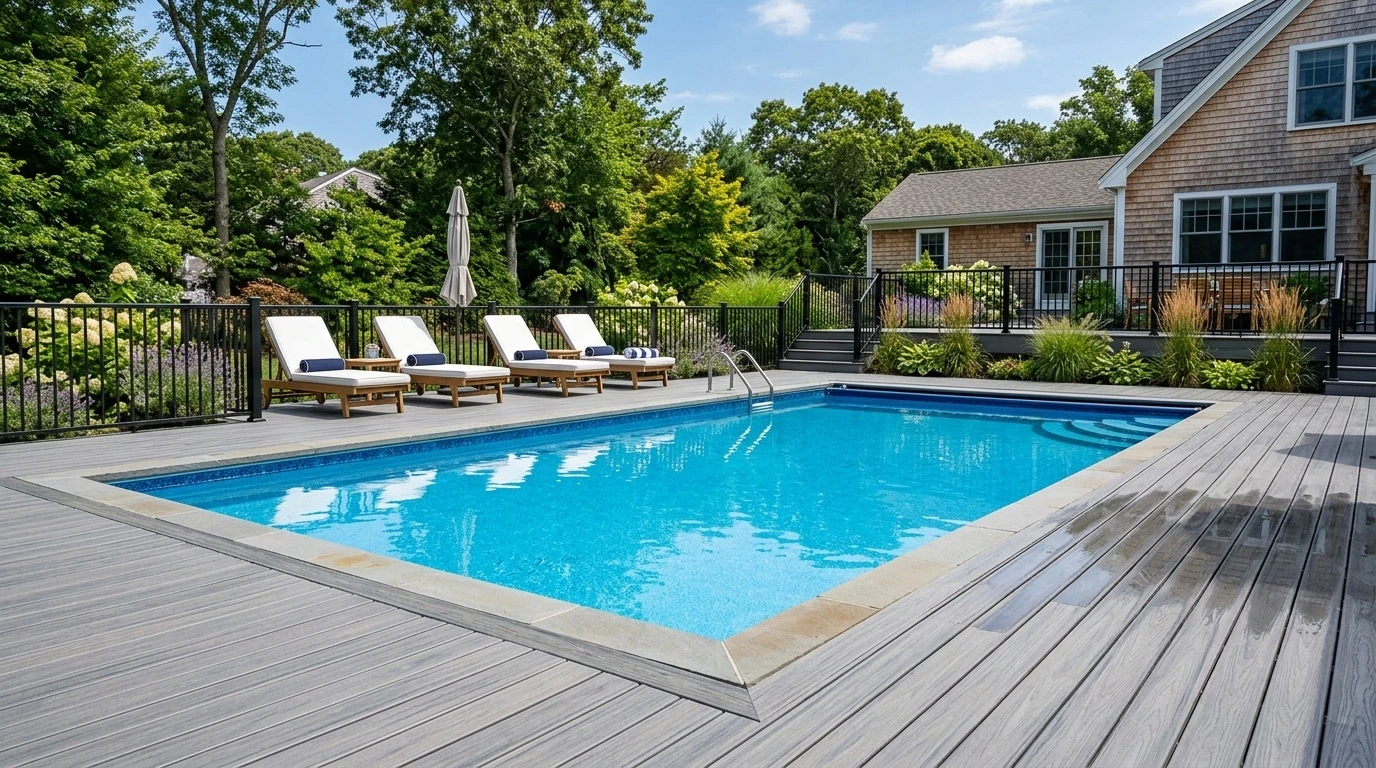
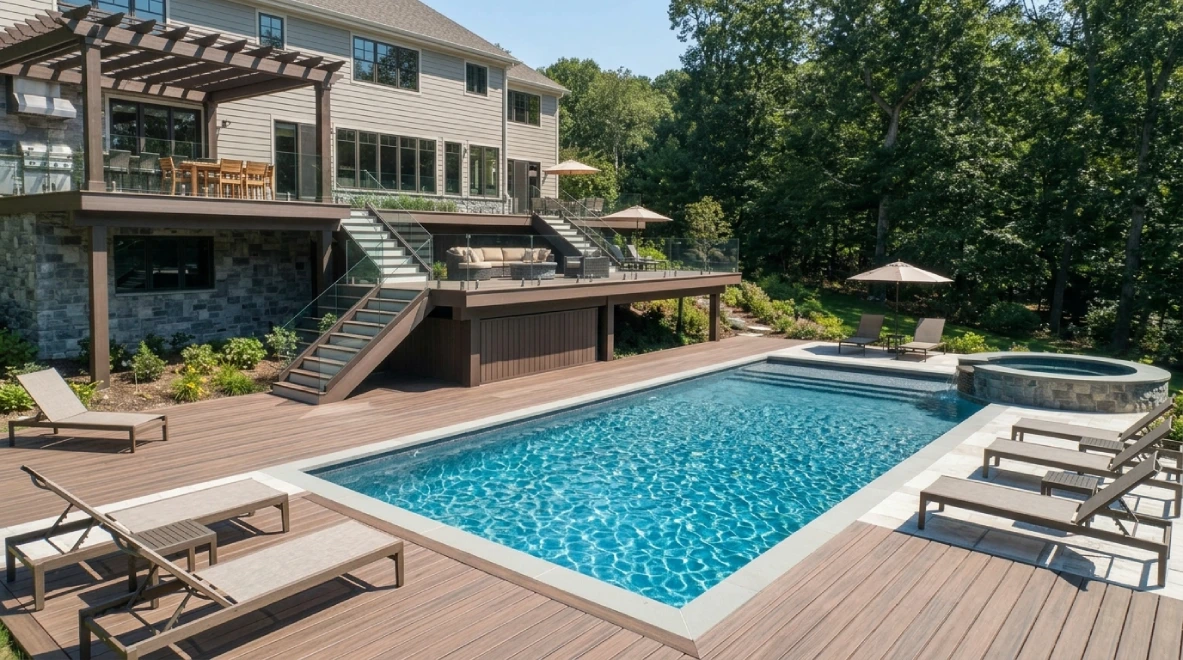
— new capping tech that runs boards meaningfully cooler in direct sun. Our take: genuinely worth it on south-facing decks and pool surrounds; unnecessary in shade.
- Hyper-realistic wood grain (TimberTech)
— deeper embossing and color blending that closes the visual gap with exotic hardwood. Our take: this is the biggest real improvement of the last few years. If composite’s “plastic look” is what put you off before, look again.
- Integrated outdoor-living systems
— brands now offer matched railing, lighting, and cladding so a whole deck comes from one family. Our take: worth it for visual cohesion; never let it lock you into a weaker component.
What's New : Composite Decking Innovations
Trex

The brand that built the composite category. Proven, traditional styles, wide availability, and a full matched ecosystem of railing and lighting.
TimberTech
Leads on realistic wood-grain texture and on-trend colors. A favorite among contractors for premium composite and PVC lines.
Fiberon
High-performance boards at a competitive price point, with sustainable, efficient manufacturing and reversible dual-face options on some lines.
Deckorators
Known for railing innovation — cable systems, glass rail kits — alongside a growing composite decking lineup with fire-resistant options.
Fortress
A steel-framing specialist, often paired with any composite decking brand above for a fully non-combustible, warp-proof substructure.
COLOR & HEAT — The New England Guide
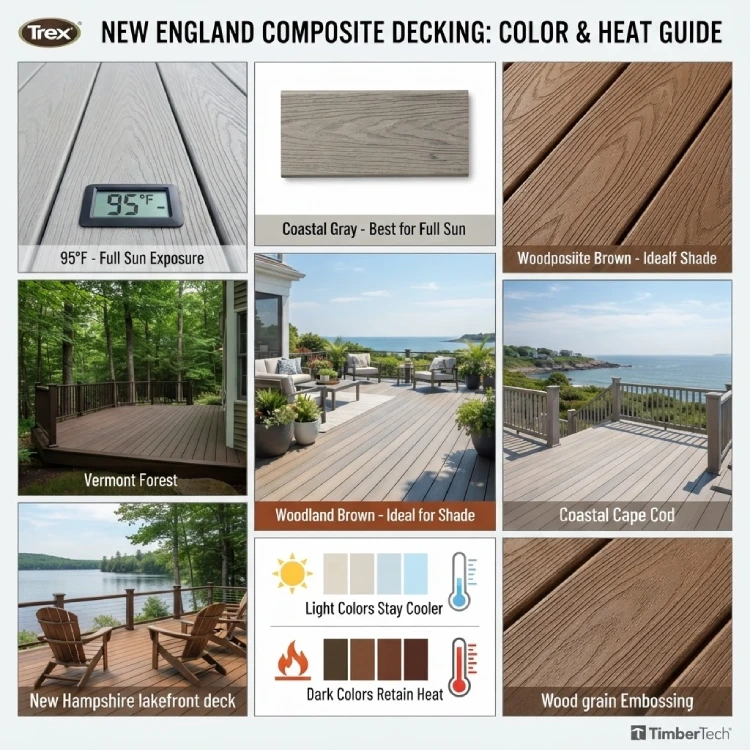
Full-sun decks (south/west facing): choose lighter tones and, if available, a heat-mitigating line. Dark boards in July are a real comfort issue.
Shaded/wooded lots (common in VT, NH, western MA): darker, warmer tones read beautifully and heat is a non-issue. Watch for mold pressure instead — capped composite handles it, uncapped does not.
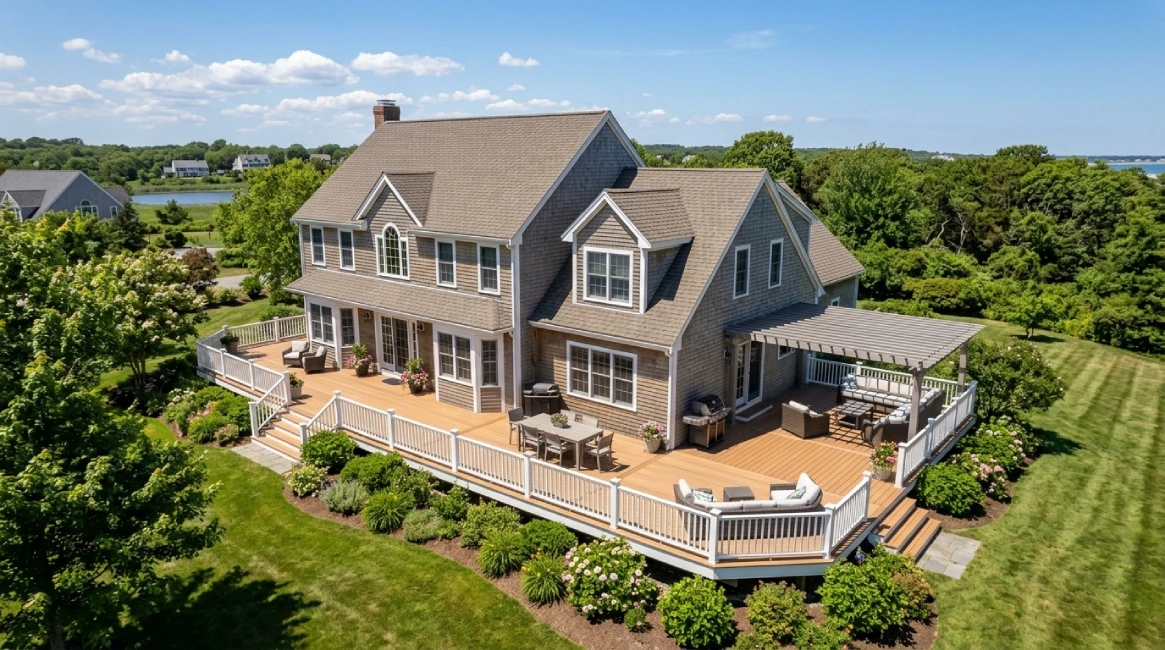
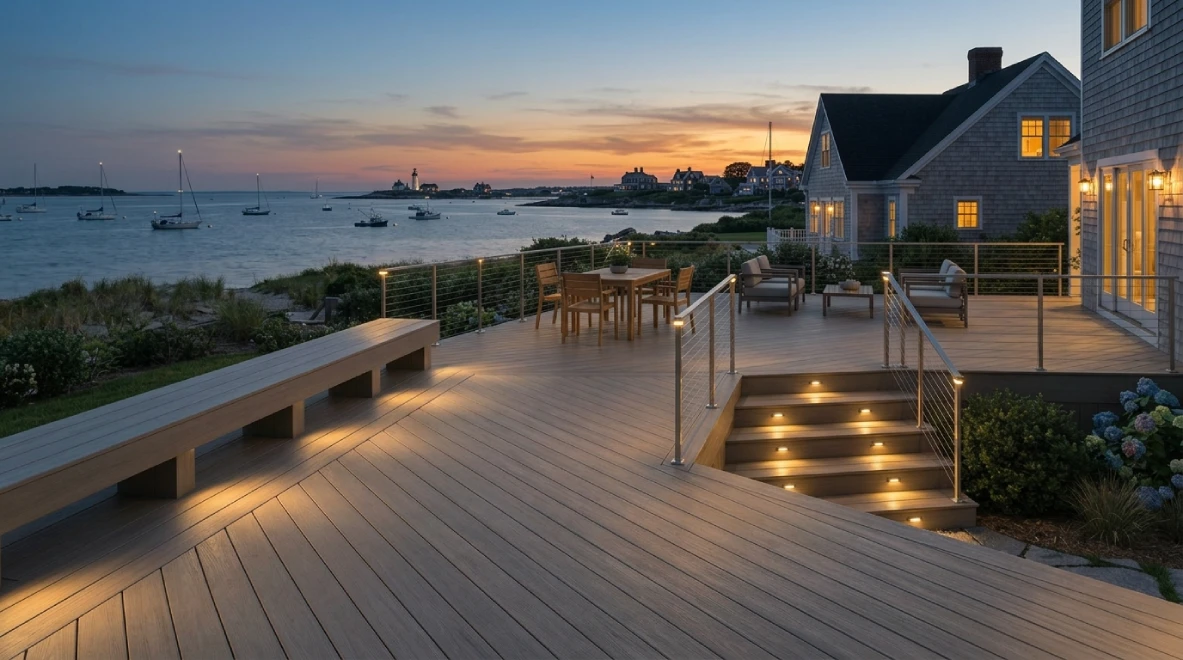
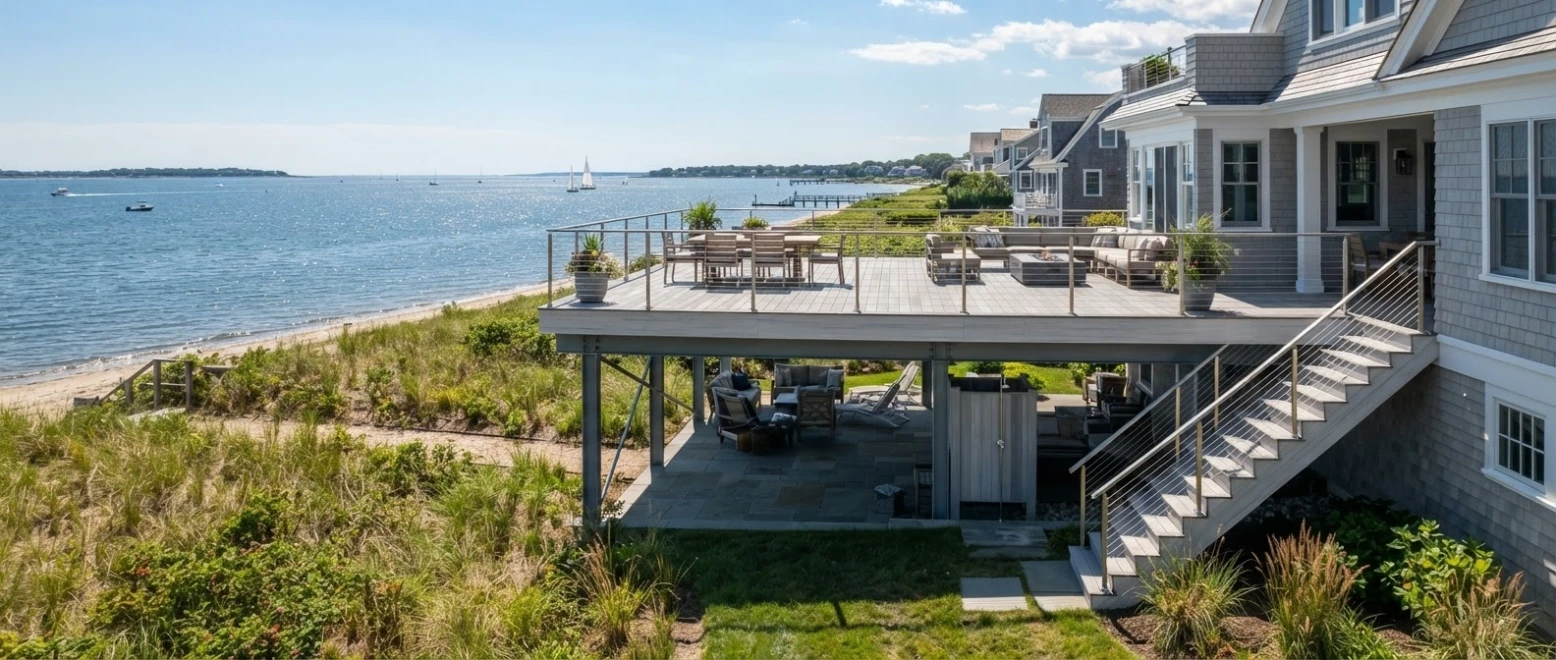
Coastal (Cape, South Shore, RI/CT shoreline): lighter grays and driftwood tones hide salt film and sand; pair with stainless hardware.
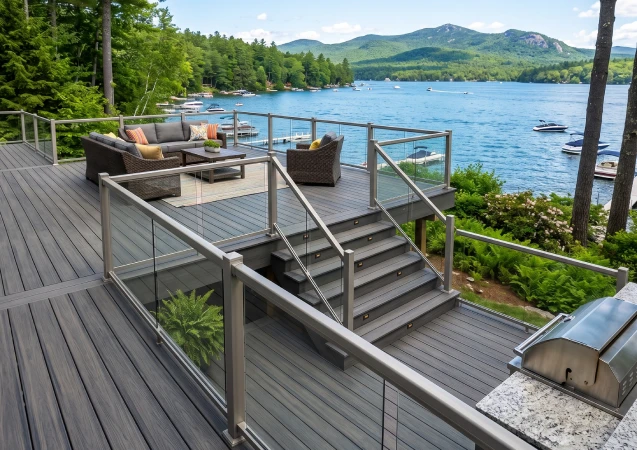
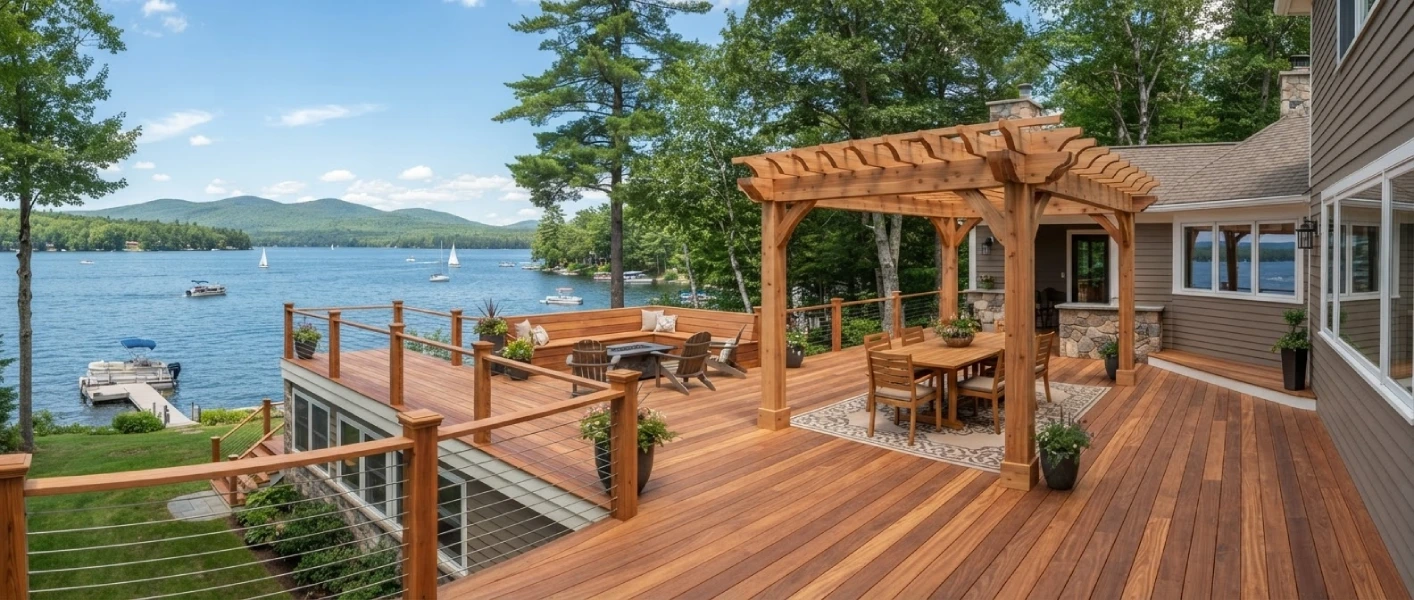
Lakeside (Winnipesaukee, Champlain): warm browns and cedar tones blend with pines; consider a natural-wood look line.

Phone number
+978 601 4092
Explore our recent project
SUSTAINABILITY
Composite is made largely from what would otherwise be waste — reclaimed wood fiber and recycled plastic diverted from landfill instead of new lumber. Leading manufacturers now build boards from majority-recycled content (Trex cites up to ~95%; TimberTech roughly 65–85% depending on line). Combined with 25–30 year warranty life, it’s a genuinely low-impact choice compared to a wood deck replaced twice in the same period.
And the New England details that matter more than any of the above: joist spacing to the board line’s spec (often 12″ O.C., not 16″), correct expansion gapping for our temperature swing, joist tape over framing, and stainless hardware within five miles of salt water.

Phone number
+978 601 4092
Installation & Fastening — Done the Clean Way
The fastening method affects how your finished deck looks and holds up. We choose based on the board and where it sits.
01.
Hidden Fasteners
Clip-in fastening through the board’s grooved edge — invisible from above.
- Smoothest, blemish-free surface
- Never punctures the board’s cap
- Easiest to replace a single board later
02.
Plug Systems
Color-matched plugs conceal a screw driven straight through the board’s face.
- Strongest hold-down of any method
- Nearly invisible once installed
- Ideal for stair treads and drink rails
03.
Face-Fastening
Color-matching screws driven straight through the board’s visible face.
- Fast, reliable, budget-friendly
- Screws camouflage into the board tone
- Best for square-edge perimeter boards
Happy users feedback
4.9
2k+ satisfied customers
"Decks US turned our sloped, unused backyard into a two-level Trex deck we use every single day. They handled the permits, finished on time, and left the site spotless. Best home decision we've made."
"We're right on the water and worried about the salt air, but they used marine-grade cable railing and explained every choice. Three winters in, our deck still looks brand new. True professionals."
"Passed inspection on the first try and the whole project came in exactly as quoted. We get compliments on the deck all the time now."
we’re proud to partner with best-in-class clients
We’d love to hear from you

Phone number
+978 601 4092
We’d love to share more with you, please complete this form and our dedicated team will get back to you shortly.
Where We Build
Local crews across New York & New England — find your team and direct line, or enter your ZIP.
Greater Boston, MetroWest, Cape Cod, Westchester, Hudson Valley & Long Island.
(617) 231-9842Hartford, Providence, Newport, Burlington, Manchester, the Seacoast & beyond.
(978) 601-4092Enter your ZIP, meet your team
Your local team & direct number appear instantly.
FAQ — Deck Railing Installation in New England
How much does a deck railing cost?
Many factors affect the cost of a deck railing, including the length of the run, the height of the railing, the number of stairs, and the material you choose. To make budgeting easy, Decks US provides free estimates that cover both materials and installation, so you get one clear, itemized price with no surprises.
Do I need a permit to install a deck railing?
Permit requirements vary by town and usually depend on the deck’s height and configuration. If Decks US installs your railing, we take care of securing the necessary permits and managing the inspection for you. If there’s anything you need to handle personally, we’ll tell you up front.
What's the best deck railing for a home near the ocean?
Powder-coated aluminum and cable or glass systems built with T316 marine-grade stainless are the best choices near the coast. Within about five miles of the ocean, standard hardware corrodes; T316 resists salt-induced pitting and is designed to last 20+ years — a detail many builders skip that matters a great deal in New England.
How long do deck railings last?
Aluminum and composite railings typically last 25 to 30 years, T316 cable systems 20+ years, and wood railings 10 to 25 years depending on upkeep. Low-maintenance materials cost a bit more up front but save years of sanding, staining, and repairs.
Can you add lighting to a deck railing?
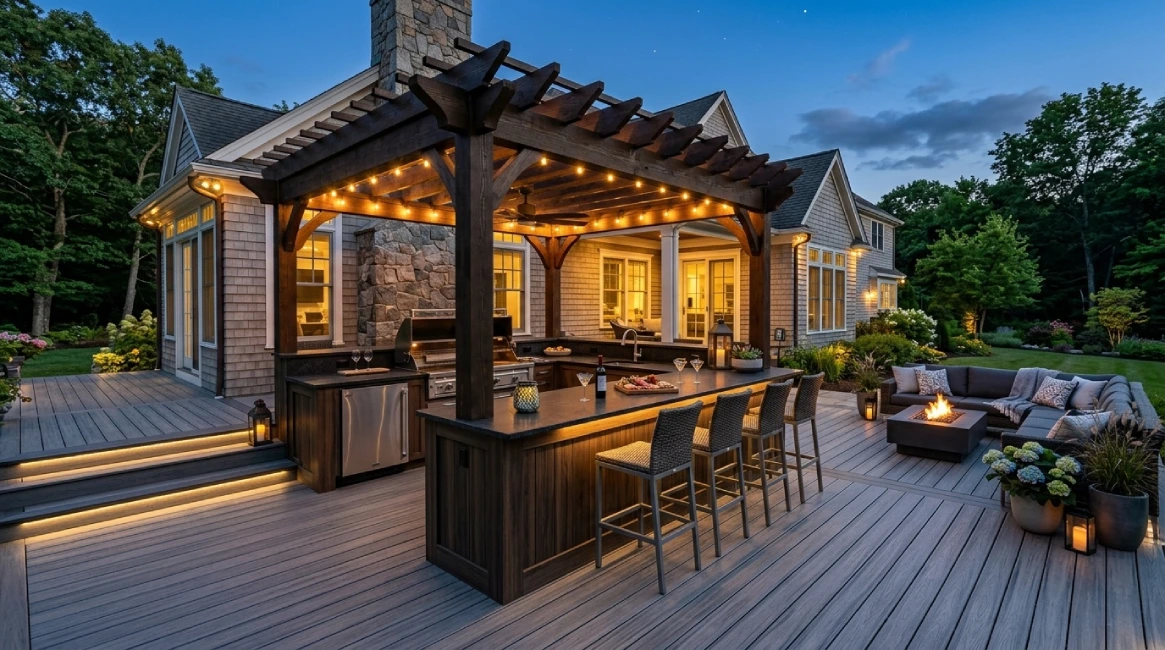
Yes. Post-cap, under-rail, and stair lighting can be built directly into your railing for both beauty and safety, turning your deck into a space you can enjoy after sunset.